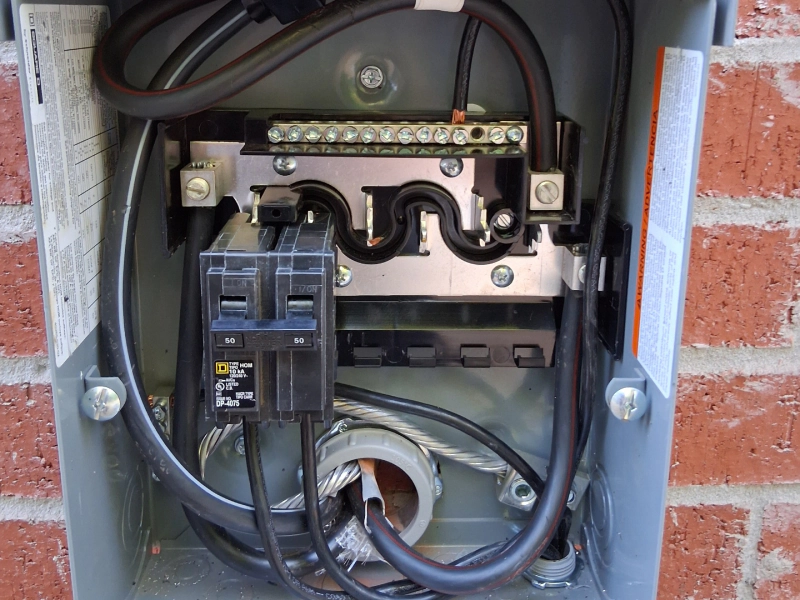
Why Your Home Might Need More Power
Level 2 EV chargers draw significantly more power than standard household appliances, typically requiring a dedicated 240-volt circuit that can handle 30 to 50 amps. Many homeowners in Bentonville overlook the fact that their existing electrical panel may already be operating near capacity, especially in older neighborhoods near downtown or along 8th Street where homes were built decades before electric vehicles became commonplace.
When you install an EV charger, you’re adding the electrical equivalent of a second air conditioning unit or electric water heater to your home’s load. In Bentonville, where summer temperatures can push air conditioning systems to run continuously for weeks, the combination of climate control demands and EV charging can quickly exceed the capacity of a 100-amp or even a 150-amp service panel. Understanding your panel’s current capacity is the first step in determining whether an upgrade is necessary before you can safely charge your electric vehicle at home.
Signs Your Panel Can’t Support EV Charging
Several clear indicators can help you assess whether your current electrical panel has the capacity for an EV charger. First, check your panel’s total amperage rating, which is typically printed on the main breaker or service entrance. Homes with 100-amp service rarely have sufficient capacity for Level 2 charging alongside modern appliances, while 150-amp panels may work if your home is energy-efficient and uses natural gas for heating and cooking.
Look for signs that your panel is already struggling: frequent breaker trips, dimming lights when large appliances start, or a panel that’s completely full with no room for additional circuits. In Bentonville, homes built before 1990 often have 100-amp service, which was adequate for the time but falls short of today’s electrical demands. If your panel feels warm to the touch, shows signs of corrosion, or has a Federal Pacific or Zinsco brand label, an upgrade is not just recommended for EV charging but for overall safety. The age and condition of your electrical wiring installation also play a role in determining whether your infrastructure can support the sustained high-amperage draw of nightly vehicle charging.
What an Upgrade Entails and Local Requirements
Upgrading an electrical panel for EV charging involves several coordinated steps. An electrical contractor will first perform a load calculation to determine your home’s actual power requirements, then size the new panel accordingly, typically 200 amps for most modern homes. The process includes coordinating with your local utility company to upgrade the service drop and meter base if needed, installing the new panel, transferring all existing circuits, and adding the dedicated circuit for your EV charger.
In Bentonville, electrical panel upgrades must comply with the National Electrical Code as adopted by Arkansas, and require permits and inspections from the city’s Building Safety Department. The timeline typically runs two to four weeks from initial assessment to final inspection, including utility coordination time. Most of the actual installation work takes one to two days, during which your home will experience a brief power outage, usually four to six hours. Cost considerations include the panel itself, labor for installation, permit fees, utility connection charges if service upgrade is needed, and the dedicated circuit for the charger. Local electricians familiar with Bentonville’s specific requirements and utility protocols can streamline the process and ensure compliance with all regulations, avoiding delays that could postpone your ability to charge at home.
When to Call an Electrician for a Professional Assessment
Many homeowners ask whether they can simply plug their EV into a standard 120-volt outlet and skip the panel upgrade entirely. While Level 1 charging using a standard outlet is possible, it’s impractically slow, adding only 3 to 5 miles of range per hour. For residents who commute to Rogers or Springdale daily, this charging speed falls short of replenishing the miles used. A Level 2 charger provides 20 to 60 miles of range per hour, making overnight charging sufficient for most driving patterns.
Another common misconception is that an upgrade is always required. Newer homes built after 2010 in developments around Bentonville often have 200-amp service installed as standard, with capacity to spare for EV charging. A thorough assessment by a qualified local electrician can determine your specific situation. Some homeowners also believe they can install a charger themselves to save money, but this work requires permits, inspections, and expertise in load calculations and code compliance. Improper installation creates fire hazards and can void equipment warranties. Working with an experienced EV charger installer ensures your system is sized correctly, installed safely, and capable of delivering the charging performance your vehicle requires without compromising your home’s electrical safety or functionality.
Ready to Power Your Electric Vehicle Safely
If you’re considering installing an EV charger at your Bentonville home, scheduling a professional assessment is the safest and most cost-effective first step. An experienced electrician will visit your property to evaluate your existing panel, measure available capacity, inspect the service entrance wiring, and calculate your home’s total electrical load with the proposed charger included. This assessment typically takes 30 to 60 minutes and provides a clear recommendation on whether your current infrastructure can accommodate a Level 2 charger or if an electrical panel upgrade is necessary.
During peak cooling months in Bentonville, when air conditioning systems strain older 100-amp panels, adding an EV charger without proper evaluation can trigger frequent breaker trips or create safety hazards. A thorough assessment will also identify any outdated wiring, insufficient grounding, or code violations that should be addressed before charger installation. The electrician will explain your options, provide a detailed cost estimate for any required upgrades, and outline the permitting process required by local building departments. Taking this proactive step ensures your EV charging setup operates safely and efficiently for years to come, and gives you confidence that your home’s electrical system can handle both your current needs and future expansion.